
In the district of Mathura, Uttar Pradesh, lies the sacred Govardhan Parvat, a hill revered in Hinduism and believed to have been lifted by Lord Krishna on his finger to protect the villagers of Vrindavan. This act of divine protection is commemorated by the Govardhan Parikrama , a sacred circumambulation that draws devotees worldwide. The parikrama is particularly significant during the festivals of Guru Purnima and Govardhan Puja when a large gathering of pilgrims can be witnessed..
The Govardhan Parikrama spans approximately 23 kilometres and typically takes 5-6 hours. However, the time taken can vary greatly depending on the individual and the type of parikrama they choose to perform.
The journey begins at the Manasi-Ganga Kund , a sacred water body where pilgrims often take a holy dip before commencing the parikrama. From here, devotees visit Lord Harideva's temple before heading towards Radha Kund Village. The route follows the Vrindavan Road , leading pilgrims to the designated parikrama path.
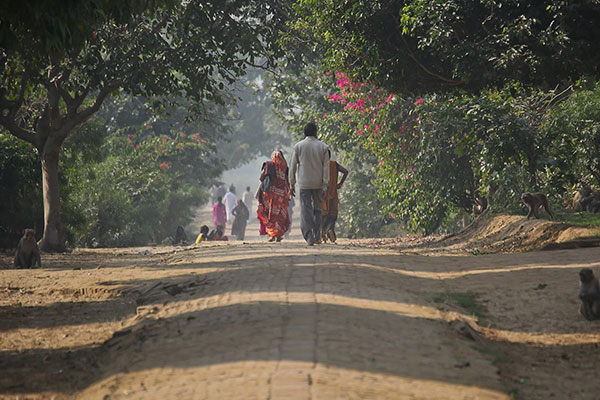
Throughout this sacred journey, devotees encounter several important holy sites, including
For those seeking a deeper spiritual experience, the Dandavata Parikrama is an intense form of devotion. In this practice, devotees offer their homage by lying flat on the ground in a prostrate position. One person marks the spot where the fingertips touch the ground, and from that point, the devotee repeats the process, slowly making their way around the entire parikrama route. This rigorous practice can take weeks or even months to complete. Some sadhus (holy men) take this devotion a step further by performing 108 dandavats (prostrations) at each spot, making the journey even more arduous and spiritually rewarding.
Another unique and sacred ritual is the Milk Parikrama, which is considered highly auspicious. In this ritual, devotees carry a pot filled with milk, which has a small hole at the bottom, allowing milk to flow out gradually as they walk. In the other hand, they hold a pot with incense (dhoop). Throughout the journey, the devotee is accompanied by a person, often a family member, who refills the pot with milk until the parikrama is complete. This continuous offering of milk is a symbol of purity and devotion, believed to bring immense spiritual benefits.
The Govardhan Parikrama is not just a physical journey but a profound spiritual practice. It is believed that performing the parikrama with devotion can cleanse sins, fulfil desires, and bring the devotee closer to Krishna. The ritual is also deeply embedded in the cultural fabric of the Braj region, which is rich in traditions of folk music, dance, and religious practices. The local communities actively participate in the pilgrimage, enhancing the spiritual atmosphere with their devotion and hospitality.
There is no fixed time limit to complete the parikrama, allowing devotees to undertake the journey at their own pace. While many complete it in a single day, others may take longer, depending on their physical condition and the specific rituals they choose to perform. The pilgrimage is particularly auspicious during the full moon (Purnima), when the energy and spiritual significance of the parikrama are heightened.
Beyond its religious significance, Govardhan Hill and the surrounding areas are also of ecological importance. The hill, composed of sandstone, supports a variety of flora and fauna, making it a site of both spiritual and environmental preservation. Efforts to protect and maintain the hill are crucial to sustaining its sanctity for future generations of devotees.
The Govardhan Parikrama is a powerful expression of faith and devotion, embodying the essence of Bhakti (devotion) in Hinduism. It connects the physical act of circumambulation with a deeper spiritual journey, offering a path to divine grace and enlightenment